Skip to main contentSkip to footer

In general, searches ignore accents, which is generally a good idea: for example in French, the difference between e and é isn’t huge, and it’s fine if the search engine isn’t too picky about which is which.

However, there are cases where there is a big difference: for example in Finnish, the letter ä isn’t an a with an accent, it’s a completely different word that is at the other end of the alphabetical order and has a different pronunciation. On most WordPress sites you can search for rätti and find ratti, which is wrong.

Relevanssi isn’t actually responsible for these mixups (and also for the useful behaviour of ignoring accents). The reason is the MySQL database collation, which controls how the data is sorted and compared. The default collation for Relevanssi tables is utf8mb4_unicode_ci, which is a good, general-purpose collation. However, in some specific cases, it may be too generic.

Finnish (and Swedish) users may want to use utf8mb4_swedish_ci, which for example makes a and ä separate letters. You can adjust the collation in the database table settings, which you can modify with tools like phpMyAdmin or Adminer. There’s a general collation for the table and specific collations for individual columns, and we’re mostly interested in the specific collations for the term and term_reverse columns.
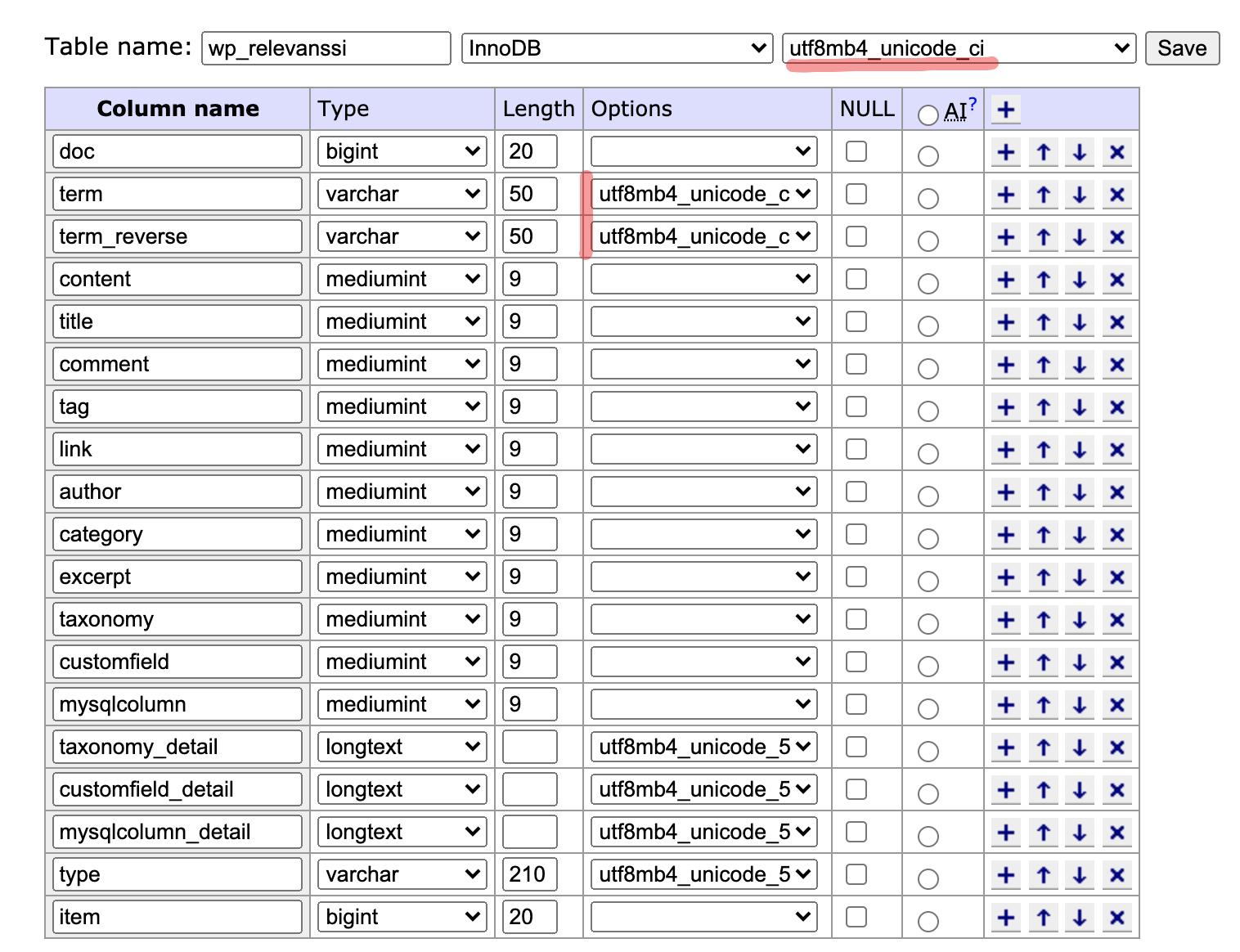
wp_relevanssi database table structure view in Adminer

If you change the collation to something that does not ignore accents, you also need to make Relevanssi keep the accents. Add this to your site:

remove_filter( 'relevanssi_remove_punctuation', 'remove_accents', 9 );

Your account

Not logged in. Log in to see your license details.

Search

Popular Resources

ACF: Indexing relationship content

…%s”, $taxonomy_info_field_name ) ); $taxonomy_field_info = unserialize( $taxonomy_field_info ); // phpcs:ignore WordPress.PHP.DiscouragedPHPFunctions $taxonomy = ”; if ( isset( $taxonomy_field_info[‘taxonomy‘] ) ) { $taxonomy = $taxonomy_field_info[‘taxonomy‘]; } // Or you can just skip all that and set the // $taxonomy variable directly. // Fetching the taxonomy term data. if ( isset(……name. This function covers fetching post data, user data and taxonomy term data. For taxonomy terms, there’s the more complete solution that figures out the taxonomy from the field settings, but if the taxonomy is never going to change, you can skip all that and just set the taxonomy in……field. The name of this field is the name // of your taxonomy connection field with an underscore prefix. $taxonomy_info_field_name = get_post_meta( $post->ID, ‘_taxonomy_connection’, true ); // Fetching the name of the taxonomy from the information field. global $wpdb; $taxonomy_field_info = $wpdb->get_var( $wpdb->prepare( “SELECT meta_value FROM $wpdb->postmeta WHERE meta_key =…

Gmedia photo gallery tags
Gmedia photo gallery gives a false impression of working with Relevanssi, as you can see the gmedia_tag taxonomy appear in…

Related Posts:

Currently there are no related posts available.

Comment Section:

Leave a Reply

Your email address will not be published. Required fields are marked *

Fill out this field
Fill out this field
Please enter a valid email address.
You need to agree with the terms to proceed